


For vacation-home owners, medevac membership concerns medical transport, not a replacement for health or travel insurance. A medevac membership for Bahamas vacation home owners should be considered alongside questions about air ambulance transport, potential destinations, repatriation, and transfers between hospitals.
Medical costs are an important part of planning a stay in the Bahamas, but the destination and type of transport matter too. The right plan depends on the care available where an emergency occurs and the patient’s medical needs.
This guide explains how membership differs from insurance, what evacuation destinations and repatriation can involve, and how interhospital transfers fit into the picture. It also describes how air-medical membership can support vacation-home owners when medical transport is needed, helping you prepare for the decisions involved.
Key Takeaways
- Compare medevac membership with travel and health insurance by checking what each covers: transport coordination, medical care, and related expenses.
- Consider how location and medical needs shape an evacuation route, including whether care in Nassau or an onward destination is appropriate.
- Understand the difference between emergency evacuation, international repatriation, and a transfer between hospitals before deciding what support you need.
- Review how membership terms apply to your household and time in the Bahamas, especially if you own a vacation home or visit seasonally.
- Explore short-term membership when you need medical transport support for a defined stay, and learn how it fits alongside annual membership and transfer services.
Medical evacuation from Bahamas family islands, resorts, and offshore vessels
The Bahamas has more than 700 islands and cays, so location can shape a medical evacuation route. A family island, resort, or offshore vessel may require transport to a facility better equipped for the patient’s needs.
Transport to Better-Equipped Facilities
Evacuation means moving someone from the place where they become ill or injured to a facility able to provide the care they need. For a vacation-home owner on a family island, the right destination may not be the nearest clinic. The patient’s condition, required specialty, and receiving facility’s ability to accept the patient all matter. The same applies to a resort guest or someone aboard an offshore vessel.
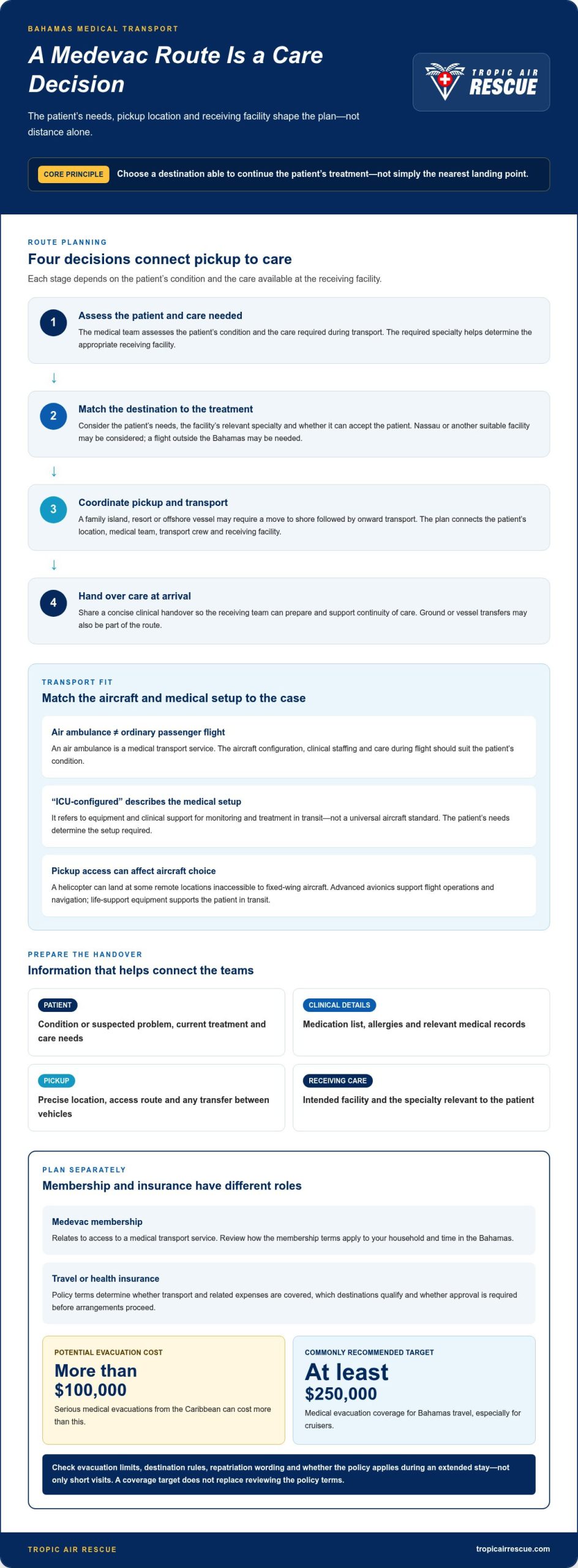
Before transport, the medical team assesses the patient and the care needed in transit. The route may include moving from a vessel or remote location to shore, followed by onward transport. The key question is not just how far the destination is, but whether it can continue the patient’s treatment.
Transport Coordination
Coordinated transport connects the patient’s location, medical team, transport crew, and receiving facility. Prepare a concise clinical handover with the patient’s condition, current treatment, medication list, allergies, and relevant records. These details help the receiving team prepare and support continuity of care during transfer.
For a resort or offshore vessel, provide a precise pickup location and clear instructions for reaching the patient. The care team plans transport around the patient’s condition and the receiving facility. For example, someone needing specialist assessment requires a destination suited to that need, not simply the nearest landing point.
Bahamas Medical Evacuation Flights and Insurance
A medical evacuation flight can move a patient from the Bahamas to another suitable facility, including one outside the country when needed. The destination depends on the care required, the patient’s condition, and the receiving facility’s capacity. A flight is only one part of the plan: ground or vessel transfers and a clinical handover may also be needed.
Keep medical evacuation travel insurance separate from membership in your planning. Insurance terms determine whether transport is covered, which destinations qualify, and whether approval is required before arrangements proceed. Serious medical evacuations from the Caribbean can cost more than $100,000. For Bahamas travel, a commonly recommended target is at least $250,000 in medical evacuation coverage, especially for cruisers. Review evacuation limits, destination rules, and repatriation wording before travel. A vacation-home owner should also consider whether a policy applies during extended stays, not only short visits.
Emergency air ambulance and ICU-configured aircraft
An air ambulance is a medical transport service, not simply an aircraft carrying a patient. In the Bahamas, that distinction matters when an emergency requires care during flight, a remote pickup, or transfer to a facility with specific capabilities. Aircraft configuration, clinical staffing, the patient’s condition, and the destination all shape the plan. An ICU-configured aircraft is set up to support medical monitoring and treatment in transit, rather than ordinary passenger travel.
“ICU-configured” describes a transport’s medical setup, not a universal aircraft standard. The equipment and clinical team need to suit the patient’s needs. For example, someone who requires close observation during flight may need a different setup from a patient stable enough for a less intensive transfer. The receiving facility matters too: the transport plan should match the care available on arrival.
Before transport, the care team assesses the patient and shares relevant clinical information with the transport team. A practical handover includes the diagnosis or suspected problem, current treatment, medications, allergies, and recent medical records. This helps the team prepare the cabin and coordinate care from pickup through arrival. If the patient is at a resort or private residence, provide a precise location and access instructions.
Aircraft type affects pickup options. A helicopter can land at some remote locations inaccessible to fixed-wing aircraft, which can matter when an ambulance cannot reach the patient directly. Advanced avionics and life-support equipment are also relevant to air-medical transport, addressing different needs: flight operations and navigation on one hand, patient support in transit on the other.
- Describe the patient’s current condition and care needs.
- Gather medical records, medication details, and allergy information.
- Identify the pickup point, access route, and any transfer between vehicles.
- Provide the intended receiving facility and its relevant specialty.
Those steps help clarify whether the planned aircraft, medical team, and destination fit the case. They also help distinguish emergency transport from a routine flight, which does not provide medical care in transit. Membership and insurance have separate roles: membership relates to access to a transport service, while insurance terms govern covered expenses and eligibility. For vacation-home owners, reviewing both can support practical peace of mind before a stay. A closer look at medical transport planning in the Bahamas can help connect these factors to the available air-medical pathway.
Evacuation to Nassau or the United States
The evacuation destination depends on the care the patient needs, not simply the shortest flight. Nassau may be appropriate if a receiving facility there can provide the required treatment. The United States may be considered if a specialised service or suitable bed is unavailable locally. For example, a patient needing a particular specialty requires a destination able to continue that care after arrival.
Start with the clinical need. The treating team identifies the required level of care and the receiving facility’s capabilities. The transport plan then connects the patient’s location with that destination. Moving from a family island to Nassau may be appropriate if care there meets the patient’s needs. A longer route may be considered when the patient needs a more specialised service elsewhere.
Distance alone doesn’t determine the route. The patient’s stability, the care needed during flight, and the receiving facility’s ability to accept the patient all shape the plan. A longer journey may involve more than air transport: ground travel to an airfield, a flight, and another transfer on arrival. Each handover should preserve the clinical information the next care team needs.
Review insurance terms before an evacuation. Check whether the policy covers transport to Nassau, onward travel to the United States, or both. Look for provisions on eligible destinations, medical necessity, prior approval, and repatriation. Policies define these benefits differently, so read the actual terms rather than assuming “medical evacuation” means transport to any preferred hospital. Keep the insurer’s assistance details and policy information accessible during your stay.
- Identify the treatment required and the facility able to provide it.
- Clarify whether the route ends in Nassau or continues to the United States.
- Review destination limits and approval requirements in the insurance policy.
- Prepare medical records and a handover for each receiving care team.
For vacation-home owners, these decisions affect household planning as well as travel arrangements. Share policy details and emergency contacts with family members staying at the property. Keep a current medication list and relevant medical records accessible, including for guests who may need assistance. In an emergency, these details help connect the patient’s condition, proposed destination, and transport plan.
The key question is whether the destination can provide suitable care. Nassau may be appropriate when a receiving facility can meet the patient’s needs; travel to the United States may be relevant when the required care calls for another destination. Membership and insurance address different parts of preparation, so consider both in relation to the intended route. This gives vacation-home owners a clearer basis for discussing evacuation options before an emergency.
International repatriation and hospital transfers
International repatriation and an interhospital transfer address different needs. Repatriation moves a patient toward home or a chosen facility in their home country after illness abroad. An interhospital transfer moves a patient between medical facilities when another hospital can provide more suitable or continued care. For a Bahamas vacation-home owner, identifying the purpose helps clarify the route, receiving facility, and insurance questions.
A doctor’s assessment guides the decision. The treating doctor describes the patient’s condition, current treatment, and next care needs. If the current hospital cannot provide that care, a transfer to a more suitable facility may be planned. If the patient is stable and needs to continue treatment closer to home, international repatriation may be considered. The route follows the clinical need, not simply the patient’s home address.
Each transfer needs a clear handover between care teams. Before departure, organize the patient’s medical summary, medication list, allergies, test results, and treating doctor’s contact details. The receiving hospital needs relevant information to prepare and continue treatment. For example, a patient transferred after an acute event should have records describing the event, treatment provided, and ongoing care needs.
Transport planning also considers the patient’s condition during travel, the appropriate medical team, and the destination’s ability to receive them. A hospital transfer may connect two facilities in the Bahamas or involve onward international travel. Repatriation may require several linked steps, such as travel from the hospital to an aircraft and then onward to a receiving facility. Keep the medical handover continuous across each transition.
- Ask the treating doctor to summarize the patient’s current status and next care needs.
- Identify whether the objective is a hospital transfer or travel closer to home.
- Prepare medical records, medication details, allergies, and receiving-doctor information.
- Review insurance wording for medical transport, repatriation, destinations, and approval processes.
Insurance coverage and transport coordination are separate parts of the plan. A policy’s repatriation terms may define eligible destinations and conditions differently from its emergency medical benefits. A vacation-home owner should keep the policy information accessible to family members, alongside the patient’s medical documents. That preparation helps clarify the intended route if a doctor recommends transfer or travel home.
For patients already in hospital, an interhospital transfer means moving between care facilities while maintaining medical continuity. It differs from a non-medical return trip: the patient’s clinical needs shape the transport arrangements and receiving-hospital handover. The practical approach is to establish the care objective first, then align the doctor’s records, receiving facility, transport plan, and insurance terms.
Do Bahamas medevac memberships cover residents, property owners, or only visitors?
Owning a vacation home in the Bahamas doesn’t automatically determine who a medevac membership covers. Membership eligibility terms identify the person covered and the conditions for assistance. A resident, property owner, seasonal visitor, or guest may have different circumstances, so distinguish the property’s status from each person’s membership status.
Start with the person enrolling. If an owner spends part of the year at a Bahamas home, consider whether membership applies to that person during the stay. Then consider a spouse, family member, or guest who may also need transport. Don’t assume membership for one person extends to everyone staying at the property.
Time matters, too. A short visit and a recurring seasonal stay create different planning needs. Membership terms can define when coverage begins, how long it applies, and whether travel outside the Bahamas is part of the arrangement. Read those details alongside any health or travel insurance policy. Insurance and membership serve different roles, so one should not be treated as a substitute for the other.
Use a simple household review:
- List each person who regularly stays at the property.
- Match each person to the membership record or policy that applies to them.
- Note the dates of seasonal visits and any changes in residence.
- Compare transport benefits with insurance terms for evacuation and repatriation.
For example, a homeowner may live in the Bahamas while a family member visits for a limited period. Their residence and travel patterns differ, but the key question is whether each person is eligible for membership during the relevant stay. A rental guest is another distinct case: property ownership alone doesn’t make the guest a member.
Residents and visitors should distinguish emergency medical transport from ordinary travel arrangements. Medevac membership provides access to eligible medical transport under its terms; it doesn’t define every hospital bill, treatment expense, or insurance benefit. Keep membership details, emergency contacts, and relevant medical information accessible at the home so family members can find them quickly.
Vacation-home owners can choose a membership duration that fits their pattern of use, such as a short-term or annual arrangement. Businesses managing staff or guests may also consider business membership plans. The practical next step is to map the people, stay periods, and transport needs before selecting the structure. Explore medevac membership options for planning around Bahamas stays.
Tropic Air Rescue: Short-term Membership
Tropic Air Rescue offers Short-term Membership for vacation-home owners seeking medical transport support during a stay in the Bahamas. Membership is required for its Concierge Helicopter Air Medical Service, and the company bills health insurers directly. Annual Membership may suit owners who return regularly. For a patient already receiving care, Interhospital Transfer Services support movement between hospitals; Organ Transport addresses a separate, time-sensitive medical need.
Consider how long and how often you stay, who needs membership, and how it fits alongside health or travel insurance. Short-term Membership can suit a defined visit, while Annual Membership may fit recurring stays. Membership is limited to natural persons, and applicants must certify they are not Medicaid beneficiaries. Review the terms with your household so everyone understands the arrangement. Contact Tropic Air Rescue to discuss membership options and medical transport services.
Make Your Preparedness Plan Personal
A medevac membership for Bahamas vacation home owners is most useful when it fits how your household uses the property. Decide who needs membership, how often they stay, and who should be able to access medical records and emergency contacts. Then align those decisions with your insurance documents and communication plan.
Tropic Air Rescue offers Short-term Membership and Annual Membership, along with Interhospital Transfer Services. Consider which membership duration fits your stays and whether hospital transfers are relevant to your planning. These are practical points to address before travel, while everyone can review the details calmly.
For a clear next step, contact Tropic Air Rescue about membership options. A considered plan can help you and your household approach time in the Bahamas with greater clarity and confidence.
Frequently Asked Questions
What medevac membership programs cover Bahamas vacation home owners?
Tropic Air Rescue offers Short-term Membership and Annual Membership to eligible individuals. A medevac membership for Bahamas vacation home owners is individual enrollment, not coverage automatically attached to a property. Membership is limited to natural persons, and applicants must certify they aren’t Medicaid beneficiaries. Consider separately whether family members or guests need their own membership.
Which hospitals and destinations are included in Bahamas medevac coverage?
The service provides emergency and interhospital transport throughout the Bahamas and coordinates with Florida trauma centers. The medical director selects the appropriate receiving hospital heliport for each case. A transfer to a Bahamas hospital and onward transport to Florida involve different routes and receiving arrangements. The destination depends on the patient’s medical needs and the receiving facility’s role in care.
What are the coverage limits, exclusions, and waiting periods for Bahamas medevac memberships?
Membership activates 48 hours after purchase, so purchase must be completed at least 2 days before arrival in the Bahamas. It’s non-refundable, non-transferable, and isn’t an insurance policy or secondary coverage. Members must maintain current medical insurance, and uncovered expenses remain their responsibility. Flights may be limited by aircraft use, equipment, regulations, maintenance, patient condition, or weather. FAA restrictions prohibit most aircraft from flying in inclement weather.
Does medevac membership cover medical evacuation from private islands or remote locations in the Bahamas?
Helicopters can land at some remote locations inaccessible to fixed-wing aircraft, which may support transport from a private or hard-to-reach location. Remote access doesn’t remove operational limits. Aircraft use, equipment limitations, regulations, maintenance, the patient’s condition, age and size, and weather can affect transport. FAA restrictions prohibit most aircraft from flying in inclement weather. Provide the precise pickup location and relevant access details during transport coordination.
What documents or local arrangements are needed to use medevac coverage in the Bahamas?
Complete pre-certification enrollment with accurate identity and enrollment information before travel. For medevac membership for Bahamas vacation home owners, keep membership details and current medical insurance information accessible to household members. Membership isn’t insurance, and members are responsible for expenses not covered by their health insurance. Also organize the patient’s medical history, medication list, and attending doctor’s contact information to support a clear clinical handover.
How do Bahamas medevac providers coordinate with local clinics, ambulances, and airports?
Coordination connects the patient’s clinical situation with transport planning and the receiving facility. Tropic Air Rescue coordinates with Florida trauma centers, and its medical director selects the appropriate receiving hospital heliport. Provide the pickup location, patient status, and relevant handover details to support planning. The medical command physician and attending medical professionals determine whether the patient is flown; a request alone doesn’t mean transport will proceed.