


A child’s medical transfer isn’t decided by distance alone. Pediatric air ambulance services involve clinical and operational assessments: the child’s condition, the time and route involved, available aircraft and equipment, and whether flying is appropriate. For families in the Bahamas, those decisions can feel urgent. Understanding the process can help you prepare and coordinate with the medical team.
It’s understandable to want to know who will care for your child in flight, what equipment is onboard, and how membership and insurance work. Tropic Air Rescue provides a membership-required helicopter air-medical service in the Bahamas, with a pilot, a critical-care paramedic, and onboard life-support equipment. The medical command physician and attending medical professionals determine whether a patient is flown. This guide explains the factors involved, information that can support coordination, and what families should understand about membership, direct insurance billing, and uncovered expenses. It also covers important limits, including the 48-hour membership activation period, the requirement to enroll at least 2 days before arrival in the Bahamas, and conditions that may affect flight operations.
Key Takeaways
- Pediatric air ambulance services are assessed based on the child’s condition, clinical judgment, transport options, and operational feasibility, not distance alone.
- Families can support coordination by following the treating team’s direction and keeping identity and relevant enrollment information accessible.
- Helicopter, fixed-wing, and ground transport differ in access and route suitability. The clinical team determines the appropriate option.
- Tropic Air Rescue membership activates 48 hours after purchase, so enrollment must be completed at least 2 days before arrival in the Bahamas.
- Membership is non-refundable and non-transferable. Members must maintain medical insurance and are responsible for uncovered expenses. Weather, aircraft use, and patient needs can affect flight operations.
When Do Pediatric Air Ambulance Services Enter the Care Plan?
Pediatric air ambulance services transport infants, children, or adolescents by aircraft when medical professionals determine that air travel is an appropriate way to move a patient between care locations. A child’s age or diagnosis alone doesn’t mean a flight is needed. The decision depends on the patient’s condition, clinical judgment, the care required during transit, and the transport options available.
An emergency transfer is a medically coordinated move prompted by a need for assessment or treatment at another facility. It differs from routine travel, such as arranging an ordinary flight home or planning a trip around an appointment. A commercial itinerary isn’t a substitute for a clinical transport plan. Background on the range of aircraft, crew roles, and configurations used in air medical services can help families understand why the aircraft is only one part of the decision.
What makes a child’s transport needs distinct?
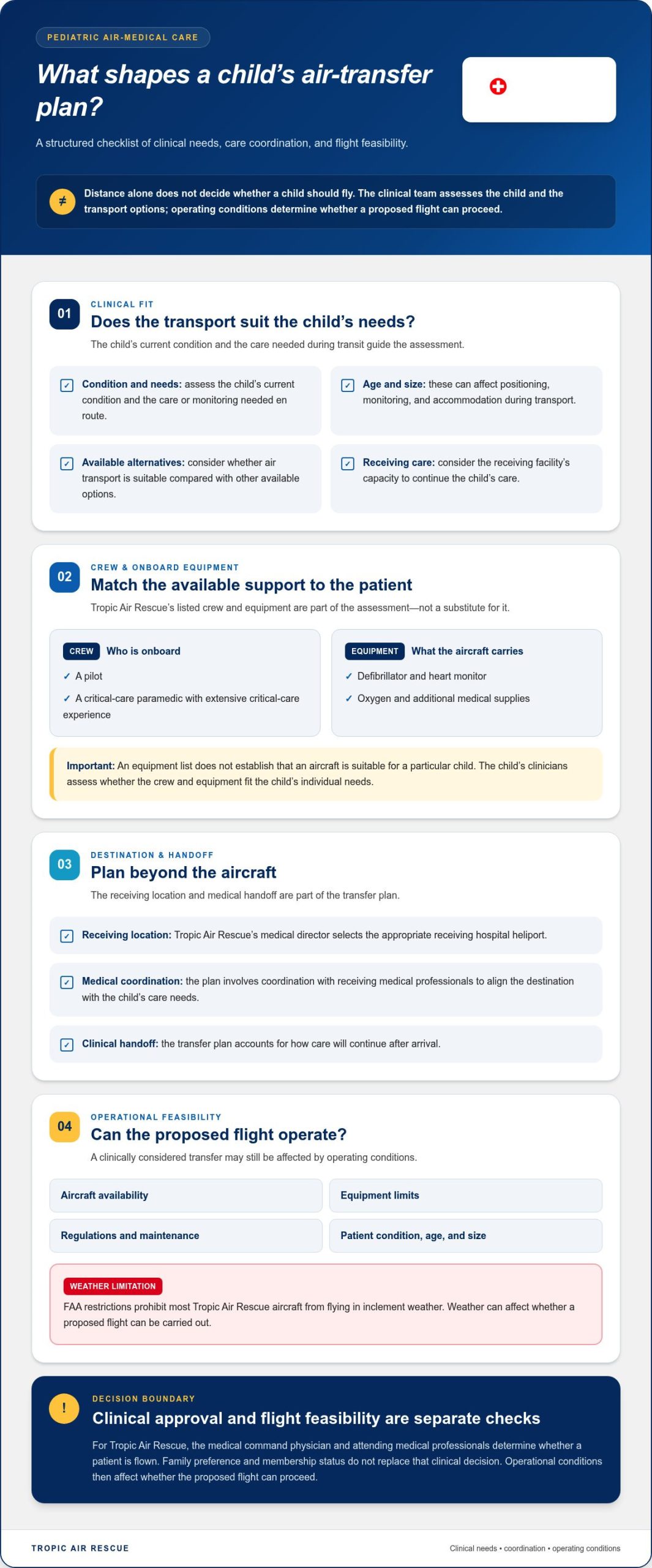
Children aren’t simply smaller adult patients. Age and size can affect how a child is positioned, monitored, and accommodated during transport. The child’s condition, equipment, and care needs also shape the plan. These factors matter alongside distance and route: a transport option must suit the patient and work for the locations involved.
The treating professionals assess the child’s current needs and the receiving facility’s capacity to continue care. For example, the team may need to coordinate where the child will be received and what clinical support is needed after arrival. Families can share information they know, but medical teams make the care and transport assessment. Crew composition and onboard equipment differ between services, so don’t assume that every air ambulance has the same capabilities.
Who helps determine whether air transport is appropriate?
The decision typically involves the professionals caring for the child and coordination with the receiving care team. They consider the child’s condition, care needed en route, and whether air transport is suitable compared with available alternatives. For Tropic Air Rescue’s service, the medical command physician and attending medical professionals determine whether a patient is flown. Family preference and membership status don’t replace that clinical decision.
There’s also an operational assessment. Aircraft availability, equipment limits, regulations, maintenance, the patient’s condition, age and size, and weather can affect whether a flight can proceed. FAA restrictions prohibit most Tropic Air Rescue aircraft from flying in inclement weather. A transport may be considered without being approved or possible at that time. The care team’s evaluation comes first, while operational conditions determine whether the proposed flight can be carried out.
For families, a practical starting point is to follow the treating professionals’ direction and ask them to explain the transfer plan, including the destination and how the receiving team is involved. The aim isn’t to decide that a flight must happen. It’s to understand how the child’s clinical needs and available transport options guide the next step.
How Pediatric Air Medical Care and Flight Coordination Are Evaluated
A transfer plan brings several decisions together. Clinicians assess the child’s condition and care needs, while transport professionals consider the crew, onboard equipment, destination, route, and operating conditions. These factors work as a system. The presence of a medical device on an aircraft does not, by itself, establish that the aircraft is suitable for a particular child.
What should families understand about crew and onboard equipment?
Tropic Air Rescue’s crew includes a pilot and a critical-care paramedic with extensive critical-care experience. Its aircraft carry a defibrillator, heart monitor, oxygen, and additional medical supplies. The AAP Section on Transport Medicine provides background on the clinical and multidisciplinary considerations involved in neonatal and pediatric transport.
An equipment list describes what may be onboard; the child’s clinicians determine whether the equipment and crew are appropriate for the child’s individual needs. A child who needs a particular type of monitoring or support may require a different transport plan from one whose needs are less intensive. The treating professionals assess those requirements rather than relying on a general equipment list.
How are the receiving facility and transfer coordinated?
Planning extends beyond the aircraft. Tropic Air Rescue’s medical director selects the appropriate receiving hospital heliport, and the transfer plan involves coordination with receiving medical professionals. This helps align the destination with the child’s care needs and plan the clinical handoff. Families can support clear communication by sharing known details with the treating team and following its direction about updates.
For inter-hospital transfers, coordination can involve the sending and receiving teams, transport arrangements, and arrival logistics. Tropic Air Rescue’s inter-hospital medical transfer coordination guidance offers further context on how those handoffs are organized.
Families can ask practical questions to understand the plan without trying to make the clinical decision themselves:
- Patient needs: What care or monitoring does the treating team expect during transport?
- Destination: Which receiving facility is planned, and how will its medical team coordinate the handoff?
- Transport fit: How do the child’s condition and needs relate to the proposed crew and onboard equipment?
- Operational factors: Could aircraft use, maintenance, regulations, equipment limits, patient factors, or weather affect the plan?
Operational feasibility matters. Aircraft availability, maintenance, regulations, equipment limits, and weather can affect whether a flight proceeds. FAA restrictions prohibit most aircraft from flying in inclement weather. A transfer plan depends on both clinical approval and operating conditions. Families can review Tropic Air Rescue membership information to understand how membership supports access to the service.
Helicopter or Other Transport: What Families Should Weigh
Transport mode is a clinical and logistical choice, not a ranking in which one aircraft is always better. The child’s condition, required care, route, access at both ends, and operating conditions all matter. For families in the Bahamas, island geography can make access especially relevant, but a helicopter isn’t automatically appropriate simply because a journey crosses water or involves a remote location.
Ground transport may suit a route where the patient can be moved between facilities by road and the clinical team considers it appropriate. A helicopter can reach some locations without an active runway, including remote sites inaccessible to fixed-wing aircraft. Fixed-wing transport generally depends on runway access, so the complete journey may also involve ground transfers to and from airports. Each mode has different access and route requirements. None guarantees a faster arrival or a better outcome in every situation.
When can helicopter access matter?
Helicopter access can be useful when the pickup or receiving location is difficult to reach by road or lacks a suitable runway. The ability to land at some remote locations may reduce the need to route every transfer through an airport. That’s an access consideration, not a promise of faster transport. The route, landing options, patient’s clinical needs, and flight conditions still shape the plan. This helicopter versus fixed-wing medevac comparison explains how those factors apply in the Bahamas.
Families may also see references to industry standards. CAMTS accreditation standards address medical transport operations, but a general comparison of transport modes shouldn’t be taken as a claim that any particular provider holds an accreditation. The practical question is whether the proposed mode, route, and care arrangements fit the patient and the locations involved.
Which limits can change the transport plan?
Even when a mode appears suitable on paper, operational conditions can change the plan. For Tropic Air Rescue, availability may be affected by aircraft use, equipment limits, regulations, maintenance, the patient’s condition, age or size, and weather. FAA restrictions mean most Tropic Air Rescue aircraft cannot fly in inclement weather. A proposed transfer is not a guarantee that a flight can proceed.
The medical command physician and attending medical professionals determine whether the patient is flown. Families can clarify the plan by asking the treating team how the route and destination align with the child’s needs, and what factors could require a change in transport arrangements. A change in mode or timing reflects the clinical and operational assessment, not a decision families are expected to make themselves.
- Access: Consider where the child is being picked up and where care will continue.
- Route: Account for whether the journey requires a runway or additional ground transfers.
- Feasibility: Recognize that aircraft, patient, regulatory, maintenance, and weather limits can affect plans.
The appropriate transport option is the one the clinical team determines is suitable and that can operate within the relevant constraints. That is central when evaluating pediatric air ambulance services.
How Families Can Prepare for a Pediatric Air Medical Transfer
A transfer can involve fast-moving decisions. Families don’t need to manage the medical plan themselves. Focus on following the treating team’s direction, sharing information you know, and keeping communication clear. If care is urgent, don’t delay it to find documents or complete a checklist. The clinicians managing your child’s care guide the next steps.
A simple sequence can help keep coordination organized:
- Follow the treating team’s instructions. Let the attending professionals lead care decisions and explain what they need from you.
- Share relevant details you know. Provide accurate identity and enrollment information when available, and pass along information the care team requests.
- Coordinate updates. Keep track of who is communicating with you and direct questions about the child’s condition or destination to the appropriate medical professionals.
What information can help the coordination process?
Keep the child’s identity information and any relevant membership enrollment details accessible where possible. You might store them together in a place you can reach easily, but don’t let finding paperwork slow urgent care. If you don’t have a detail immediately, tell the care team what you do know and follow its direction about anything else needed.
Tropic Air Rescue’s pre-certification enrollment collects identity and enrollment information in advance. Completing enrollment makes that information available ahead of time to support coordination if a transport request arises. It doesn’t guarantee aircraft availability or flight approval; clinical and operational factors still determine whether transport proceeds.
What should parents expect during coordination?
Medical professionals guide decisions about the child’s care and receiving facility. The attending team assesses the patient and coordinates the clinical plan, while receiving professionals contribute to arrangements for continued care. Families can support this process by giving clear answers, sharing relevant information, and following instructions from the team responsible for the child.
Expect the plan to depend on clinical judgment and operational conditions, rather than on a family’s preference alone. Questions about the child’s treatment belong with the attending professionals. If details change, listen for updated instructions and make sure information is passed through the care team’s communication channels. Don’t assume a specific flight time or procedure before the professionals coordinating the transfer provide it.
For broader context on emergency transfers in the islands, Tropic Air Rescue’s trauma air transport guidance explains considerations relevant to the Bahamas. Preparing identity and enrollment details in advance can make coordination more orderly, while leaving medical decisions with the professionals involved.
Families planning ahead can review membership and pre-certification information before travel. For pediatric air ambulance services, preparation means keeping useful details accessible and staying aligned with the treating team, not trying to direct the flight or clinical plan.
Tropic Air Rescue Pediatric Air Medical Service: Membership, Scope, and Limits
Tropic Air Rescue provides a membership-required concierge helicopter air-medical service throughout the Bahamas, including inter-hospital transfers. Membership is a service arrangement, not an insurance policy or secondary health coverage. Understanding the terms before travel can help families distinguish what membership provides from the clinical and operational decisions involved in every transport.
What does membership mean for families?
Membership activates exactly 48 hours after purchase. To meet the advance enrollment requirement for travel to the Bahamas, purchase must be completed at least 2 days before arrival. Pre-certification enrollment collects identity and enrollment information in advance, supporting coordination if a transport request arises. Enrollment does not guarantee that a flight will be approved or available.
Members must maintain active medical insurance. Tropic Air Rescue bills health insurers directly, eliminating out-of-pocket flight expenses at the time of flight, subject to membership terms and insurance limitations. Members must remit insurer or third-party payments up to the amount charged. Those payments are not out-of-pocket flight expenses, but any amount not covered by insurance remains the member’s responsibility. Membership does not pay expenses beyond health-insurance reimbursement.
Eligibility and terms matter. Membership is limited to natural persons, not organizations. Applicants must certify that they are not Medicaid beneficiaries. Memberships are non-refundable and non-transferable. These conditions apply whether or not a family expects to use the service, so review them as part of travel preparation rather than during a stressful transfer request.
What operational and legal limits should readers know?
Membership does not guarantee a flight. Availability can be affected by aircraft use, equipment limits, regulations, maintenance, the patient’s condition, age or size, and weather. FAA restrictions prohibit most Tropic Air Rescue aircraft from flying in inclement weather. The medical command physician and attending medical professionals determine whether a patient is flown, based on clinical judgment and relevant operational factors.
Non-member requests may be accepted or refused. An emergency membership fee may apply, and membership cannot be revoked after service is rendered. The medical decision and operational feasibility remain separate from membership status. Pediatric air ambulance services are subject to the same clinical and operational limits; membership alone does not determine whether transport proceeds.
Claims are governed by United States law, specifically the laws of the State of Florida, without regard to conflict-of-law principles. Liability is limited to actual damages, capped at the amounts actually received or the membership fee paid. These terms define important boundaries alongside the membership and insurance conditions.
Transport is never guaranteed, and weather, aircraft, patient, or other operational limits may prevent a flight. For a clear review of the service terms before travel, explore Tropic Air Rescue membership.
Make Preparedness Part of the Plan
For families in the Bahamas, preparation can begin before a medical need arises. Keep important identity and enrollment information accessible, understand membership terms before travel, and follow the treating medical team’s guidance if a transfer becomes necessary. Pediatric air ambulance services involve a clinical decision, not a choice families need to make alone. Tropic Air Rescue’s critical-care crew, onboard medical resources, and advance enrollment process are relevant parts of the service, but they don’t guarantee that a flight will be approved or available.
Review the service terms while there’s time to consider them, including how membership and insurance responsibilities work. Preparation can help you approach an unexpected situation with clearer expectations and focus on your child’s care.
Explore Tropic Air Rescue membership and take a considered step toward travel preparedness.
Frequently Asked Questions
Is a pediatric air ambulance appropriate for every child?
No. Air transport is considered only when medical professionals determine that it fits the child’s condition and care needs. A child who needs transfer between facilities may be suitable for ground transport, air transport, or another plan, depending on the circumstances. For pediatric air ambulance services, the decision isn’t based on age or family preference alone. Follow the treating team’s guidance, and don’t delay urgent care while trying to arrange a particular transport mode.
How is a child assessed for helicopter medical transport?
The attending professionals assess the child’s condition and the care needed during transfer, then consider whether the proposed transport and destination are appropriate. For a helicopter flight with Tropic Air Rescue, the medical command physician and attending medical professionals determine whether the patient is flown. Families can help by providing accurate information about the child and relaying relevant updates from the treating team. Membership status doesn’t replace the clinical assessment or determine the flight decision.
Can a parent or guardian travel with a child on an air ambulance?
A parent or guardian shouldn’t assume they can travel aboard. Whether an accompanying adult can be accommodated depends on the specific aircraft and operational circumstances, while the child’s care and safe transport remain the priority. Families can prepare for the possibility that travel arrangements may be separate from the patient’s transfer. Follow instructions from the medical professionals coordinating care, and don’t make plans that depend on a guaranteed seat for a caregiver.
What equipment is used during pediatric air medical transport?
Equipment varies by service and transport plan, so a general list shouldn’t be treated as a pediatric-specific inventory. Tropic Air Rescue aircraft carry a defibrillator, heart monitor, oxygen, and additional medical supplies. Its crew includes a pilot and a critical-care paramedic. The child’s treating professionals assess whether the available crew and equipment fit the individual care requirements; the equipment list alone doesn’t establish that a particular flight is suitable.
What happens if weather prevents a helicopter flight?
Weather can make a flight impossible or delay the plan. FAA restrictions prohibit most Tropic Air Rescue aircraft from flying in inclement weather, so don’t assume a flight will proceed until operating conditions allow it. The attending medical professionals continue to guide the child’s care and determine appropriate next steps. Follow their instructions, and don’t treat a proposed flight time as confirmed when weather or other operating conditions may change.
Does Tropic Air Rescue membership cover a child’s flight?
Membership provides access to the air-medical service under its terms, but it isn’t insurance or secondary coverage. Members must maintain active medical insurance. Tropic Air Rescue bills health insurers directly, with no out-of-pocket flight expense at the time of flight, subject to membership and insurance limits. Members are responsible for uncovered expenses. Membership applies to an enrolled natural person, so a parent’s enrollment shouldn’t be assumed to enroll a child automatically.
How far in advance must membership be purchased before arriving in the Bahamas?
Purchase must be completed at least 2 days before arrival in the Bahamas to meet the advance enrollment requirement. Membership activates 48 hours after purchase, so buying closer to arrival won’t satisfy that timing. Families planning travel can keep enrollment information accessible after completing the process. Membership remains subject to its terms and operational limits, and advance purchase does not guarantee that a flight will be available or approved.